


DAITO MANABE Solo Exhibition "RELATIONAL TIME"
Life Beyond Simulation
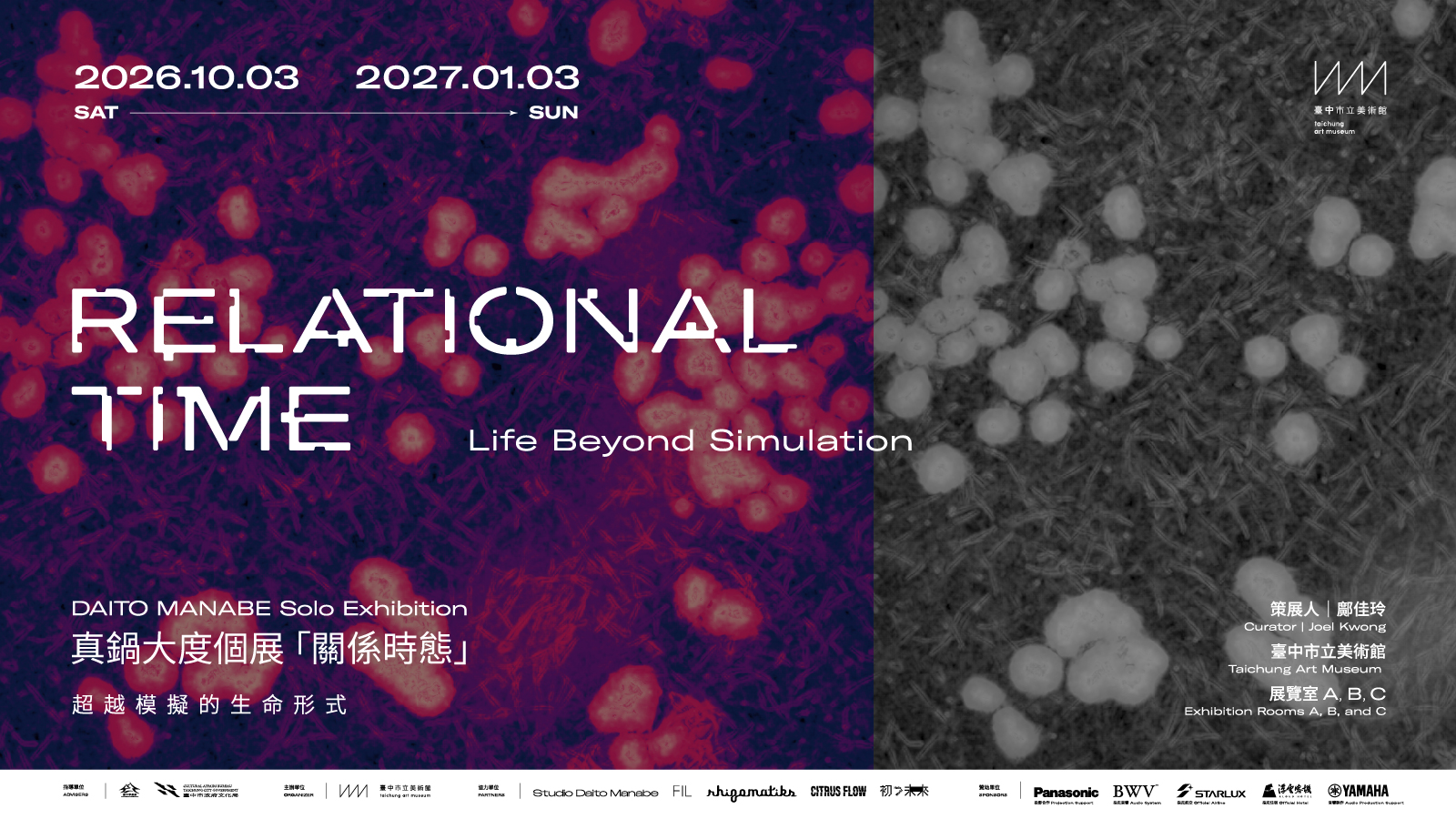
2026/10/03 – 2027/01/03
Taichung Art Museum|Exhibition room A, B, C
A machine can simulate a thousand futures in a single second, while a human being may require years to build trust, a few suspended seconds to hesitate, and immeasurable stretches of time to heal or remember; computation accelerates forward, yet relationships gather slowly within the flow of lived experience. Relational Time begins from this ground; it arises from a simple yet decisive recognition: relationships are not contents placed inside time, nor is time a neutral container through which events pass. Relationship itself requires duration in order to come into being.
The difference between humans and machines is therefore not reducible to speed, but to the temporal structures each inhabits. Today, these structures are entangled. Machine prediction shapes human judgment, human action recalibrates computational states, and those recalibrated states persist, feeding back into the environment and conditioning what follows. Within this mutual implication, time no longer proceeds as a single linear current; it emerges between heterogeneous forms of existence, generated through cycles of interaction, becoming a relational tense — a grammar of coexistence.
Over the past two decades, Daito Manabe’s practice has moved through a series of distinct questions and experimental phases, each approaching from different angles the problem of how relationships might be constructed through computation. In the early 2000s, this investigation crystallized as Artificial Synesthesia, a structural method for building operational correspondences among sound, image, body, space, and algorithmic process. Perception was reorganized, reordered through systems of translation and equivalence. In this trajectory, Manabe resonates with Iannis Xenakis, who transformed mathematics and architecture into engines of musical generation, and with Oskar Schlemmer, whose geometric abstraction repositioned the body within spatial systems. From modernist abstraction of the body to contemporary algorithmic modelling of behaviour, mathematics ceases to function merely as a tool; it becomes a framework through which perception and time are organized. Gradually, the emphasis on inter-sensory mapping shifted toward a deeper reciprocity between bodies and machines. With the integration of machine learning, interaction unfolded not as preconfigured response but as adaptive modulation across duration. Systems learned from human gesture, humans adjusted in response to computational feedback, and a fluid field of co-regulation took shape. The work moved from translation to feedback, from fixed correspondence to mutual adaptation.
In recent years, this framework has expanded once more. The situation is no longer one human confronting a singular intelligent system, but an individual situated within an ecology of multiple autonomous agents evolving across extended temporal scales. Memory, negotiation, cooperation, and competition interweave to generate distributed intelligence. Relational structures stabilize, fracture, and reorganize within shared environments. What we call artificial life here is a dynamic condition of sustained interdependence.
The exhibition unfolds across three interdependent spaces. The first renders visible the internal dynamics of a simulated agent society, where states, exchanges, alignments, and conflicts surface through continuous recalculation. The second incorporates visitors into this ecology; movement and duration of presence become environmental variables that modulate agent behaviour, sometimes immediately, sometimes through delayed transformation embedded in system memory. The third forms a distributed sonic field moving through architectural space, accompanied by a real-time interface revealing processes of self-organization, while sound traces the shifting topology of relations. Each day resumes from accumulated states, memory persists as parameter rather than recollection and processes extend beyond exhibition hours. What emerges is a temporal field woven from embodied duration, architectural resonance, and algorithmic iteration.
If relationships require time in order to exist, and if time itself now arises from the entanglement of divergent temporal structures, what kind of duration are we already sharing? And how might it transform our understanding of coexistence?
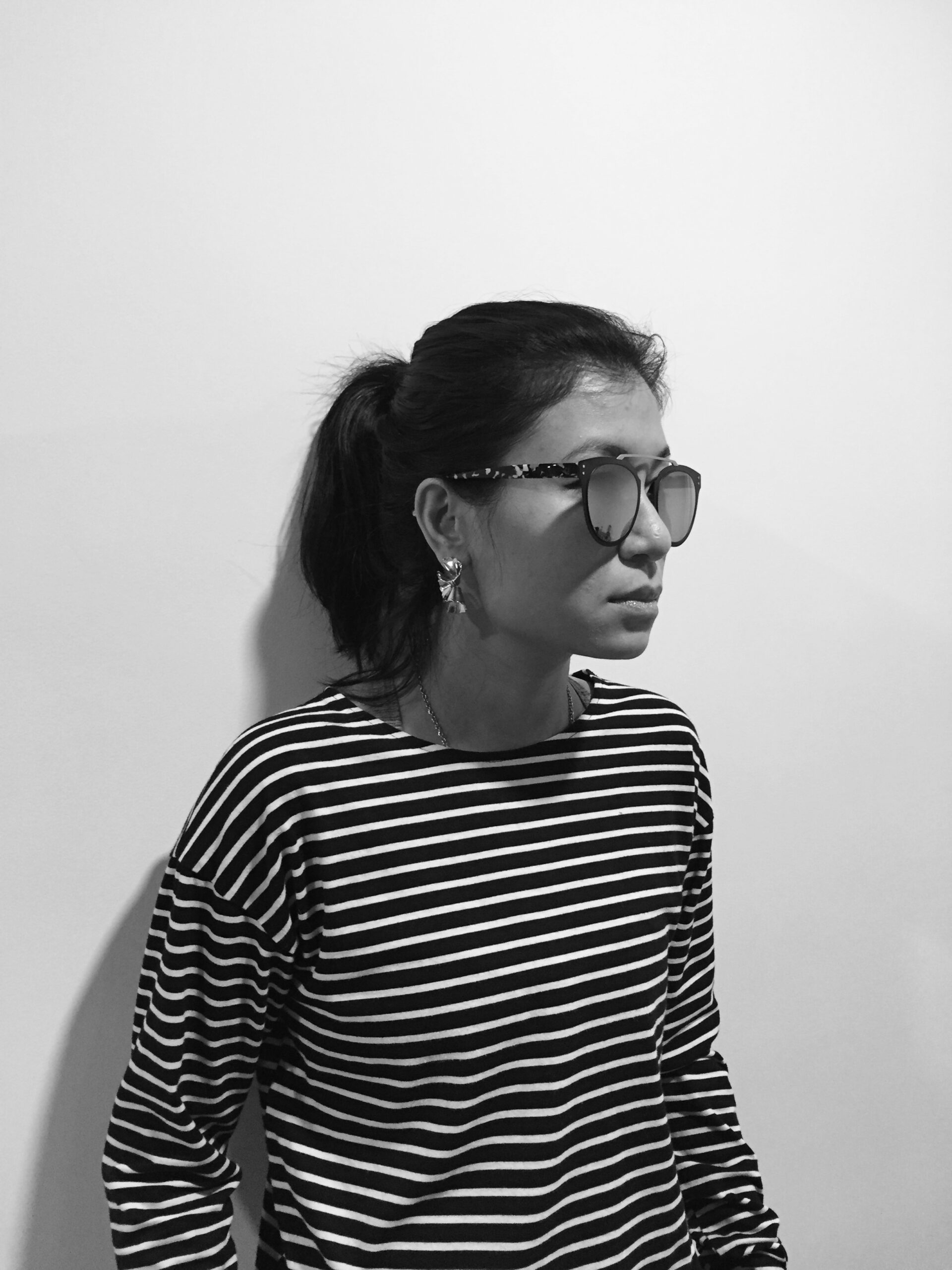
Curator | Joel Kwong
Joel Kwong is an international media art curator, producer, and writer based in Hong Kong. She is the Programme Director of the Microwave International New Media Arts Festival and the founder of SIBYLS, a creative consultancy focused on art and technology. With nearly two decades of experience across Asia, her practice bridges media art, performance, digital culture, and technological innovation. She actively engages in global art-tech discourse as curator, speaker, researcher, and jury member.
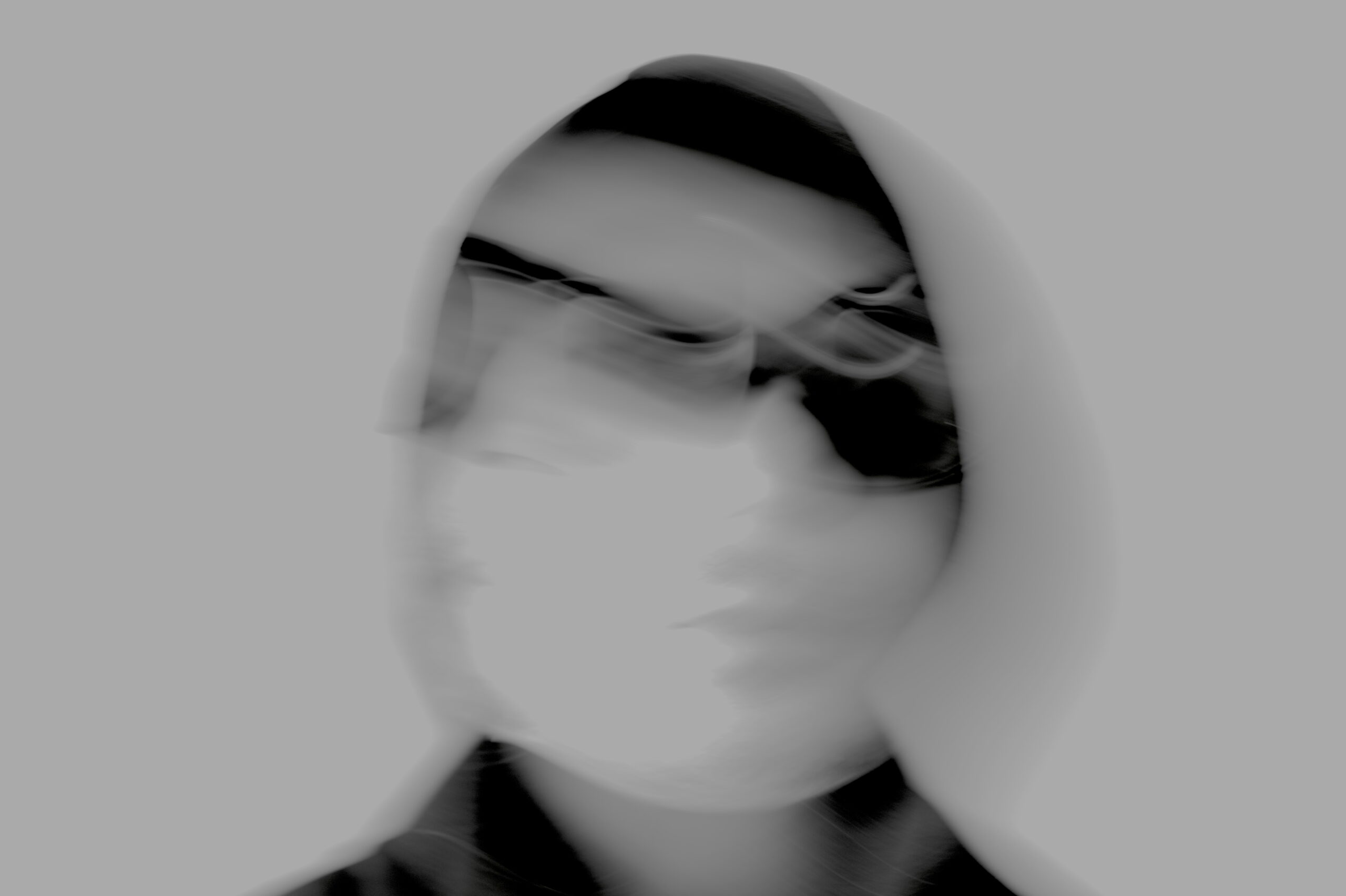
Artist | Daito Manabe
Daito Manabe is an artist, programmer, and composer whose work explores how life, intelligence, and society emerge through music, computation, and audiovisual media.
After founding Rhizomatiks in 2006, he developed works combining programming, music, visual art, and performance. His early research investigated feedback between the human body and machines by transforming motion, muscle activity, and physiological signals into sound and images. His practice later expanded to cultured neural networks, brain organoids, and spiking neural networks, treating biological activity itself as a generative medium.
His current research focuses on societies composed of humans, artificial life, and AI agents, exploring how interaction, adaptation, and emergence can become new methods for generating music and moving images.
Alongside his research, he develops large-scale performances, museum installations, and public artworks. He contributed technology development, visual systems, and lighting systems for the Tokyo Handover Ceremony at the Closing Ceremony of the Rio 2016 Olympic Games, and has collaborated with artists including Perfume, Ryuichi Sakamoto, Björk, Nosaj Thing, and Squarepusher.