'%3e%3cpath%20d='M112.379%201.12192C112.379%200.75794%20112.219%200.393963%20111.919%200.201864C111.448%20-0.11156%20110.838%200.0299866%20110.528%200.464737L76.103%2048.7321C75.9429%2048.9545%2075.6027%2048.8433%2075.6027%2048.5703V1.13203C75.6027%200.768051%2075.4425%200.404074%2075.1423%200.211975C74.672%20-0.10145%2074.0615%200.0299866%2073.7513%200.474847L39.3266%2048.7422C39.1665%2048.9646%2038.8262%2048.8534%2038.8262%2048.5804V1.12192C38.8262%200.75794%2038.6661%200.393963%2038.3659%200.201864C37.8955%20-0.10145%2037.2851%200.0299866%2036.9749%200.464737L2.54012%2048.7321C2.38%2048.9545%202.03976%2048.8433%202.03976%2048.5703V1.03092C2.03976%201.03092%202.03976%200.939929%202.03976%200.899487C2.03976%200.848934%202.03976%200.788272%202.03976%200.737719C2.03976%200.666946%202.01974%200.596173%202.00973%200.525399C1.98972%200.464737%201.96971%200.404074%201.92968%200.333301C1.90966%200.292859%201.87964%200.252417%201.83961%200.211975C1.79958%200.171533%201.74955%200.141202%201.70952%200.120981C1.63947%200.0805389%201.57943%200.060318%201.51938%200.040097C1.44933%200.0198761%201.37928%200.00976562%201.30923%200.00976562C1.2592%200.00976562%201.19915%200.00976562%201.14912%200.00976562C1.10909%200.00976562%201.05905%200.00976562%201.01902%200.00976562C0.978994%200.00976562%200.928958%200.00976562%200.888929%200.00976562C0.838893%200.00976562%200.77885%200.00976562%200.728814%200.00976562C0.658763%200.00976562%200.588713%200.0299866%200.518663%200.040097C0.458619%200.060318%200.398576%200.0805389%200.328526%200.120981C0.288497%200.141202%200.248468%200.171533%200.20844%200.211975C0.168411%200.252417%200.138389%200.302969%200.108368%200.333301C0.0683388%200.404074%200.0483244%200.464737%200.02831%200.525399C0.00829564%200.596173%20-0.00171155%200.666946%20-0.0117188%200.737719C-0.0117188%200.788272%20-0.0117188%200.848934%20-0.0117188%200.899487C-0.0117188%200.939929%20-0.0117188%200.990481%20-0.0117188%201.03092V52.5842C-0.0117188%2052.9482%200.148396%2053.302%200.448612%2053.5042C0.91895%2053.8076%201.52939%2053.6761%201.83961%2053.2414L36.2744%204.974C36.4345%204.75157%2036.7747%204.86279%2036.7747%205.13577V52.5741C36.7747%2052.9684%2036.9649%2053.3526%2037.3051%2053.5346C37.4652%2053.6256%2037.6354%2053.666%2037.7955%2053.666C38.1157%2053.666%2038.4259%2053.5144%2038.6261%2053.2414L73.0508%204.974C73.2109%204.75157%2073.5512%204.86279%2073.5512%205.13577V52.5741C73.5512%2052.9684%2073.7413%2053.3526%2074.0816%2053.5346C74.2417%2053.6256%2074.4118%2053.666%2074.5719%2053.666C74.8921%2053.666%2075.2024%2053.5144%2075.4025%2053.2414L109.837%204.974C109.997%204.75157%20110.338%204.86279%20110.338%205.13577V52.6752C110.338%2052.6752%20110.338%2052.7662%20110.338%2052.8066C110.338%2052.8572%20110.338%2052.9178%20110.338%2052.9684C110.338%2053.0392%20110.358%2053.1099%20110.368%2053.1807C110.388%2053.2414%20110.408%2053.302%20110.448%2053.3728C110.468%2053.4133%20110.498%2053.4537%20110.538%2053.4941C110.578%2053.5346%20110.628%2053.5649%20110.668%2053.5851C110.738%2053.6256%20110.798%2053.6458%20110.858%2053.666C110.928%2053.6862%20110.998%2053.6963%20111.068%2053.6963C111.118%2053.6963%20111.178%2053.6963%20111.228%2053.6963C111.268%2053.6963%20111.318%2053.6963%20111.358%2053.6963C111.398%2053.6963%20111.448%2053.6963%20111.488%2053.6963C111.539%2053.6963%20111.599%2053.6963%20111.649%2053.6963C111.719%2053.6963%20111.789%2053.6761%20111.859%2053.666C111.919%2053.6458%20111.979%2053.6256%20112.049%2053.5851C112.089%2053.5649%20112.129%2053.5346%20112.169%2053.4941C112.209%2053.4537%20112.239%2053.4031%20112.269%2053.3728C112.309%2053.302%20112.329%2053.2414%20112.349%2053.1807C112.369%2053.1099%20112.379%2053.0392%20112.389%2052.9684C112.389%2052.9178%20112.389%2052.8572%20112.389%2052.8066C112.389%2052.7662%20112.389%2052.7156%20112.389%2052.6752V1.12192H112.379Z'%20fill='black'%20/%3e%3c/g%3e%3cdefs%3e%3cclipPath%20id='clip0_1827_67485'%3e%3crect%20width='114'%20height='54'%20fill='white'%20/%3e%3c/clipPath%3e%3c/defs%3e%3c/svg%3e)

Taichung Art Museum Press Release 1 Taichung Art Museum Announces 2026 Program Highlights From Tropical Culture and Tech Art to Central Taiwan’s Art History, Fostering Manifold Dialogue and an Inclusive Experience
The Taichung Art Museum (TcAM) officially opened on December 13, 2025. TcAM, together with the Taichung Public Library, forms the new cultural landmark Taichung Green Museumbrary, located within Central Park, where art, reading, architecture, and nature converge to create a cross-disciplinary, inclusive space that sparks imagination.
Rooted in Taichung’s rich history and urban experience, TcAM explores how art responds to contemporary life and public issues. Through exhibitions, research, collections, and educational programs, the museum is evolving into a regional hub for central Taiwan. Open to the public and actively engaged with the international art community, it serves as a vital space for learning, exchange, and cultural experience.
The 2026 program continues to concern humanity’s ties to the environment and the city, highlighting central Taiwan’s place in the global art scene through international collaborations and curatorial projects informed by local research. By combining tropical culture, tech art, and the region’s art history, the program demonstrates how art examines contemporary life and historical narratives, offering visitors a multilayered experience and integrating art into daily life through a range of educational initiatives.
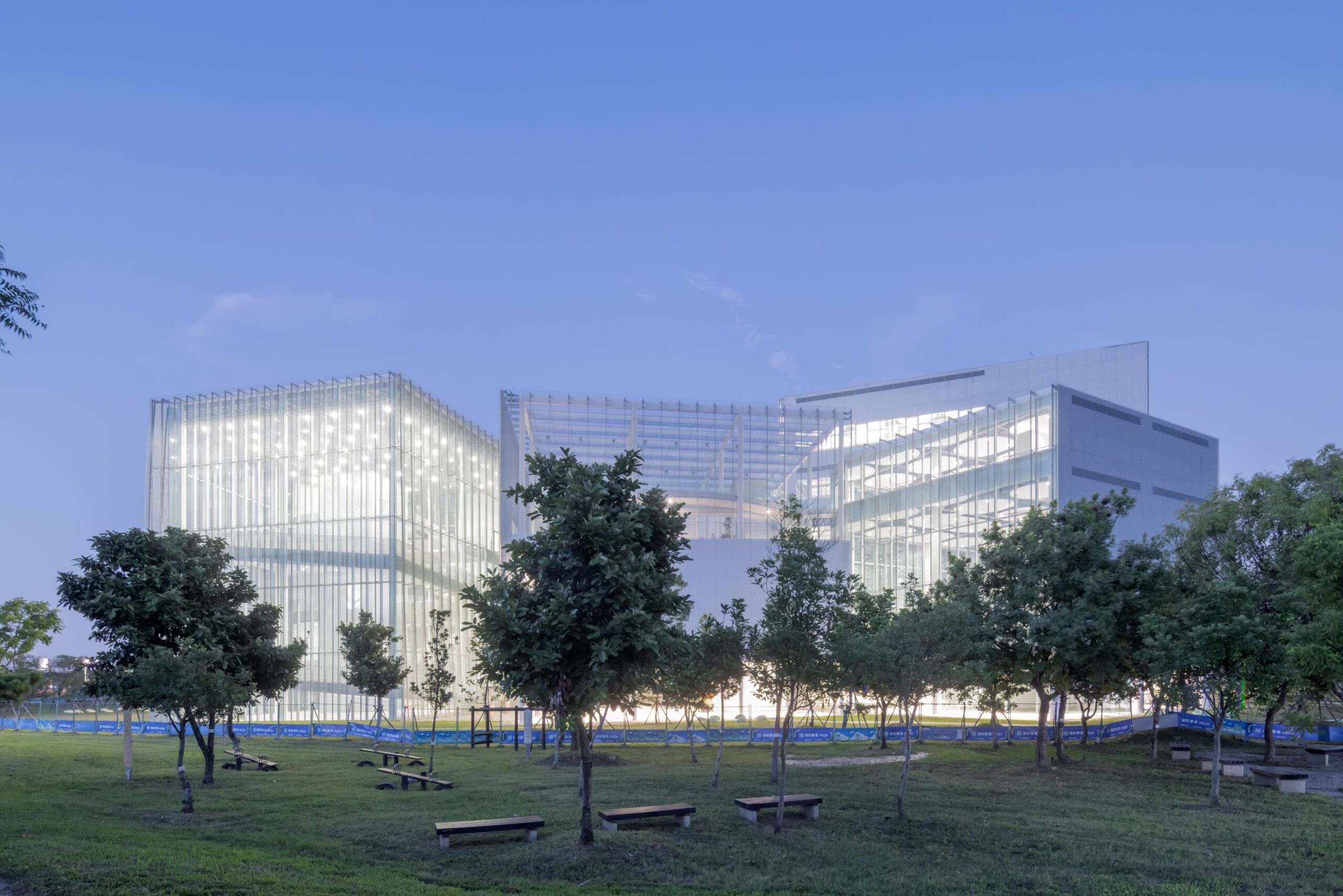
Exterior of Taichung Green Museumbrary, Courtesy of Taichung Art Museum. Photo_ Iwan Baan.
Courtesy of Taichung Art Museum
Two International Collaborations: Cross-Cultural Dialogues from Tropical Culture to Digital Perception
The upcoming exhibition Horizon Ablaze opens in May, curated by guest senior curator Takamori Nobuo; Tessa Maria Guazon, director of the Jorge B. Vargas Museum at the University of the Philippines; Juan Canela, chief curator of the Museum of Contemporary Art of Panama; and Jennifer Choy, curator of the Museum of Contemporary Art of Panama.
Curatorial teams from Taiwan, the Philippines, and Panama have shaped the exhibition through multiple venues and research exchanges, evolving it into an organic project focused on tropical culture and embodied experience. Featuring artists and works from Taiwan, Southeast Asia, Southern Europe, and Central America, the show investigates how tropical climates mold cultural experience, bodily perception, and artistic practice, highlighting interactions across diverse tropical regions and cultural contexts.
Spanning Taiwan’s sultry summer months, the exhibition presents the many dimensions of heat through a variety of mediums and perspectives. Rooted in colonial history, it reconsiders tropical imagination, and reflects on the dialectical relationship between modernity and local specificity.
EPISTEMIC PROTOCOLS (working title), Daito Manabe’s first solo exhibition in Taiwan slated to open in September, is curated by Joel Kwong, a Hong Kong media art curator and program director of the Microwave International New Media Arts Festival. Daito Manabe is an internationally renowned media artist, best known for his eight-minute presentation for Tokyo 2020, created for the closing ceremony of the 2016 Rio de Janeiro Olympics.
A graduate of the Tokyo University of Science, Daito Manabe leverages his academic background in pure mathematics and music to allow his creative process to flow freely between two disciplines, producing an art form often described as a new paradigm at the intersection of art, science, engineering, and popular culture.
Conceived for the museum’s high-ceiling exhibition room, the exhibition presents Manabe’s latest work, which integrates algorithms, music programming, and three-dimensional architectural data. Sound, moving image, and spatial form coalesce to create an immersive environment infused with technology, sound, and light, expanding the possibilities of tech art.
Two Locally Curated Exhibitions: Tracing the Formation and Transformation of Central Taiwan Art History
Since its formal launch in 2024, TcAM has undertaken extensive explorations and research into urban art history and art archives, elements of which will gradually take shape as a series of exhibitions beginning in 2026. Opening in May, The Covenant of Dadu: A Diplomacy of Things between Mountains and Seas , curated by Shen Yu-Chang, assistant professor at the Department of Cultural and Creative Industries Management, National Taipei University of Education, marks TcAM’s first research-based exhibition to methodically review the artistic trajectory of the Taichung region.
Centered on the Dadu Plateau, the exhibition introduces the concept of inter-object diplomacy, emphasizing that the formation of a city is not driven by human agency alone, but emerges from the interplay, negotiation, and coexistence of land, rivers, crops, technologies, architecture, and human communities. Approaching Taichung’s artistic milieu through the dual lenses of terroir and the city, the exhibition traces the region’s art-historical trajectories, and invites the viewer to reconsider central Taiwan’s role in the broader contexts of Taiwan’s history and art.
Featuring more than 70 works by artists from different generations, the exhibition unfolds across four themes, complemented by a number of newly commissioned contemporary works. Together, they examine how central Taiwan has gradually framed a distinctive cultural landscape through the interweaving of natural environments, transportation infrastructure, industrial activity, and everyday life, charting the evolution of central Taiwan art from its historical foundations into the present.
Swinging A-Go-Go: Wang Shuei-He, an Interdisciplinary Legend (working title) is set to open in late August. Developed from TcAM’s ongoing art archive initiative, the exhibition surveys the research and documentation of Wang Shuei-He, a seminal senior artist in central Taiwan, with a focus on his architectural and design drawings, sculptural works, oral-history interviews, and urban field studies. The exhibition is curated by Hsu Yuan-Ta, assistant professor in the Department of Art History at Tainan National University of the Arts.
Regarded as one of the emblematic self-taught artists in Taiwan’s art history, Wang Shuei-He’s work was deeply embedded in the visual culture of his time, appearing across film advertising, tourism and leisure industries, and popular culture. He also left Taichung a remarkable legacy of architecture and visual design rendered in a highly distinctive style, demonstrating an interdisciplinary practice that straddled scales and media.
Through Wang’s creative practice, TcAM reexamines key trajectories in the development of postwar Taichung’s visual culture and urban landscape, revealing how a generation of artists responded to the demands of their era and shifting social conditions to forge a vernacular aesthetic, while prompting a reconsideration of central Taiwan’s art history in a contemporary context. One of the exhibition’s highlights is a digital model of the Nan-Ye Grand Dance Hall, reconstructed through digital technology and virtual reality (VR) to evoke a major entertainment venue in Taichung between the 1970s and 1980s. Approached through spatial scale and atmosphere, this reconstruction invites the viewer to experience the metropolitan mood of the a-go-go era, and to engage with local history and the city’s collective memory.
From Art Archives to International Forums: Enriching Central Taiwan Art History
Building on previous research into central Taiwan art history, TcAM will continue in 2026 to explore how artistic dynamics have responded to the region’s urban character and local identity. Using art archives as a starting point, the project combines field investigations with systematic study, focusing on sculptor Chen Hsia-Yu (1917–2000) and his Japanese-language letters, diaries, and manuscripts from the early 1950s to illuminate Taiwan’s postwar art and cultural exchanges. It also examines the creative notes, sketches, and correspondence of postwar female artist Chen Shing-Wan (1951–2004), alongside the manuscripts and related archives of Ni Tsai-Chin (1955–2015), artist, critic, and former director of the National Taiwan Museum of Fine Arts. Through these primary materials, the research reveals the artists’ creative arcs within their historical context, delineating a multifaceted portrait of Taiwanese art history.
In addition, TcAM will host an international forum in the second half of the year under the theme “Collections and Art History.” (working title) The forum will shed light on how museum collections connect diverse art-historical perspectives, research practices, and contemporary issues, while foregrounding the evolving significance of museum collection storage. Once seen as a behind-the-scenes support space, the repository is now transitioning into a vital site that integrates research, exhibition, technology, and environmental concerns. The forum invites the public to reassess the function of the city art museum in contemporary society, not merely as a place for preserving works of art, but as an essential platform for documenting local art history, addressing technological and environmental challenges, and bridging urban culture with visions of the future.
Shaping an Inclusive, Cross-Disciplinary Artistic Experience
TcAM will continue to expand public services and art education through diverse programs that respond to the needs and experiences of its audiences. Alongside a new lecture series exploring the museum’s future directions, the architecture educational program will build on last year’s success with its first collaboration with rural schools, developing more in-depth museum–school curricula. Last year’s educational projects, Illuminating the Storeroom and Play Space Plug-in, will continue to guide viewers through the museum’s architecture and collections. This year, participatory teaching tools and interactive installations inspired by works of central Taiwan artists and tied to special exhibitions will further elevate viewer engagement with the exhibitions.
TcAM is also launching a new exhibition educational program revolving around perception and connection. Viewers are invited to take part in guided walks, writing, visual exploration, and sensory activities that link the experience of viewing art with inner life. The museum is advancing its accessibility and inclusivity initiatives, including easy-access visit maps and guided tours for diverse communities. With the newly opened Quiet Room and the Inclusive Space set to open in April, TcAM provides a welcoming environment for visitors with varying physical and mental needs to comfortably navigate and immerse themselves in art.
In addition, TcAM is launching a residency program in collaboration with the Taichung Public Library— two institutions that each collect, preserve, and interpret the world, and whose dialogue holds expansive, as-yet-realized possibilities. The residency program invites creators from any field to question what a repository can be: a field of potential encounter, interpretation, and making, as much as a collection of objects or texts. The program explores what becomes possible when the boundary between archive and exhibition hall, between repository and repertoire, is held open—cultivated rather than crossed. Residents can leverage the library’s resources and the museum’s exhibition spaces to investigate contemporary society and local culture through reading, writing, translation, and reinterpretation, transforming the Taichung Green Museumbrary into a dynamic, open-ended arena of creation and dialogue.
Looking ahead to 2026, TcAM will continue to take Taichung’s historical context and cultural depth as its point of departure, while strengthening connections with the international art world. Through these dialogues, the museum seeks to catalyze forward-thinking exchanges shaped by diverse perspectives, cultivating an inclusive, multifaceted artistic experience. For more information on upcoming exhibitions and programs, please visit TcAM’s official website: https://www.tcam.museum/en
Taichung Art Museum 2026 Program Highlights
A Call of All Beings: See you tomorrow, same time, same place
Exhibition Dates: December 13, 2025–April 12, 2026
Exhibition Venue: Exhibition Rooms A–E, Taichung Art Museum
Horizon Ablaze
Exhibition Dates: May 15–August 30, 2026
Exhibition Venue: Exhibition Rooms A, B, and C, Taichung Art Museum
The Covenant of Dadu: A Diplomacy of Things between Mountains and Seas
Exhibition Dates: May 8–August 2, 2026
Exhibition Venue: Exhibition Rooms D and E, Taichung Art Museum
Swinging A-Go-Go: Wang Shuei-He, an Interdisciplinary Legend (working title)
Exhibition Dates: August 28–October 25, 2026
Exhibition Venue: Exhibition Rooms D and E, Taichung Art Museum
Daito Manabe: EPISTEMIC PROTOCOLS (working title)
Exhibition Dates: September 25, 2026–January 3, 2027
Exhibition Venue: Exhibition Rooms A, B, and C, Taichung Art Museum
Learning Through the Collection: Illuminating the Storeroom
Exhibition Dates: Starting December 13, 2025, for a two-year run
Exhibition Venue: B2 Collection Learning Space, Taichung Art Museum
Educational Program: Play Space Plug-in
Exhibition Dates: Starting December 13, 2025, permanent exhibition
Exhibition Venue: Taichung Green Museumbrary
Taichung Art Museum Visitor Information
Opening Hours: Tuesday–Sunday 9:00–17:00; Saturdays 9:00–20:00; open on national holidays.
Official Website: https://www.tcam.museum/en
Facebook: https://www.facebook.com/TaichungArtMuseum
Instagram: @taichungartmuseum
Media Kit
https://reurl.cc/53gM6v
Issued by Taichung Art Museum
Press Contact
Léa Tseng
+886 (0)4 2369 6333 #537 / +886 (0)933 760 187 / a106050162@taichung.gov.tw
Megan Lan
+886 (0)4 2369 6333 #605 / +886 (0)911 666 949 / meganlan@taichung.gov.tw